What ticks this website
Welcome to the “meta” post where I pull back the curtain on the website you’re currently reading. When I set out to build this portfolio, my main goal was performance; I wanted that “instant-load,” distraction-free feel you get from platforms like Medium. To achieve that, I bypassed heavy JavaScript frameworks and chose Astro. Astro’s magic trick is shipping zero JavaScript by default, meaning these pages are essentially pure, lightweight HTML delivered straight to your browser. For styling, I used Tailwind CSS, which allowed me to rapidly prototype this minimalist, typography-centric design without getting lost in endless CSS files.
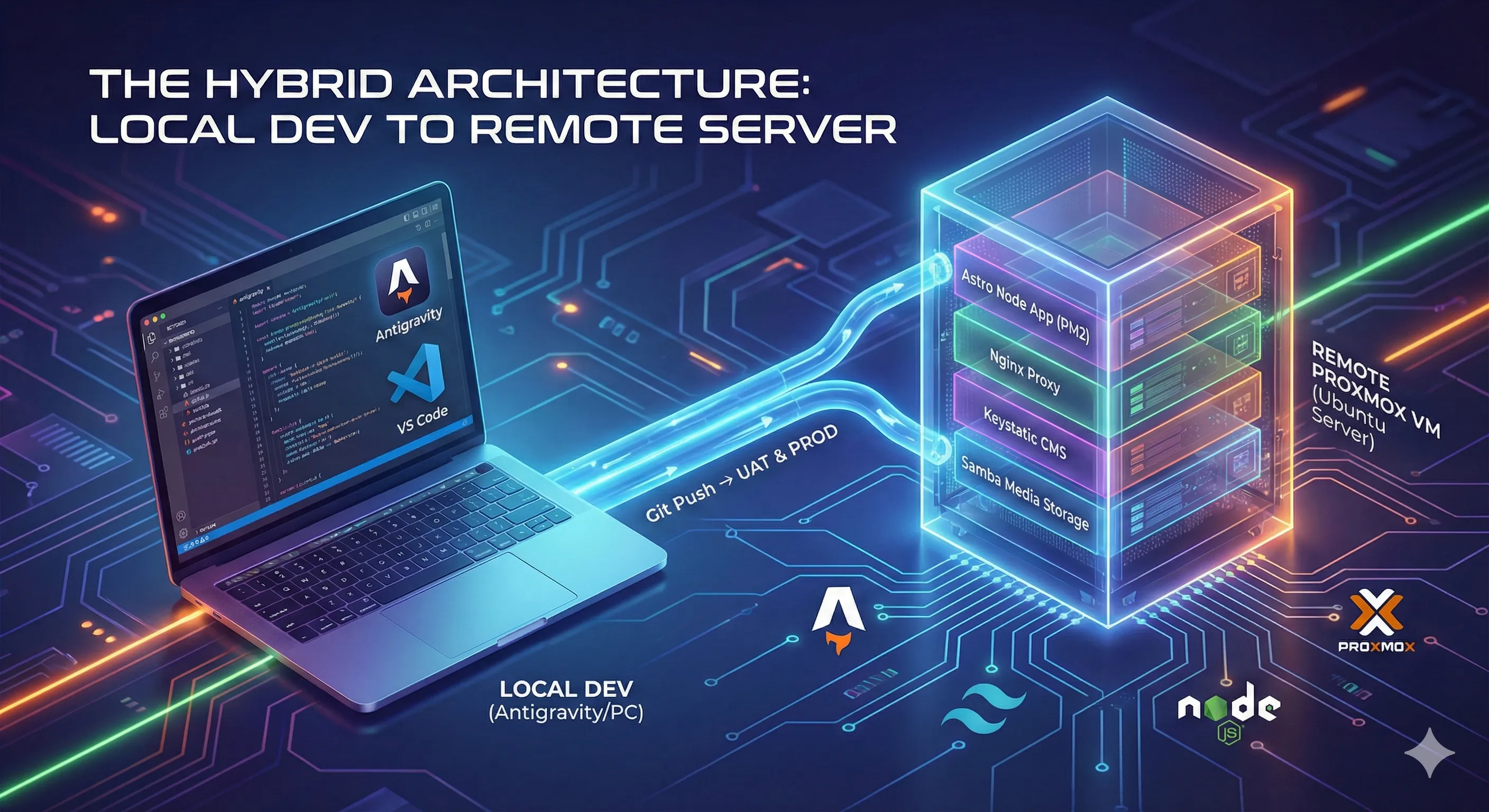
But the real fun lies in the infrastructure. I’m a big believer in self-hosting, so this site doesn’t live in some nameless cloud; it runs on my own dedicated 24/7 Ubuntu server, virtualized on Proxmox in my homelab. My development workflow, however, starts on my local Windows machine using Google’s Project IDX (Antigravity) for an AI-supercharged coding environment. I architected a custom “push-to-deploy” pipeline to bridge these two worlds. The moment I push code via Git from my local machine, my server’s hooks automatically catch it, install dependencies, build the site, and deploy it live. It is a deeply satisfying, automated Rube Goldberg machine.
Here is the interesting twist: even though this feels like a simple static site, it actually has a “brain.” I’m running Astro in hybrid mode alongside Nginx and PM2, which allows me to use Keystatic. Keystatic is a fantastic Git-based CMS that lets me write these posts using rich MDX components through a beautiful UI, all without needing a heavy traditional database. Furthermore, to keep my Git repository lean, I don’t store heavy media assets in the code. Instead, I set up a dedicated Samba network share on my server; I just drag and drop images there, and Nginx serves them directly to you. It’s a complex system designed to look deceptively simple.